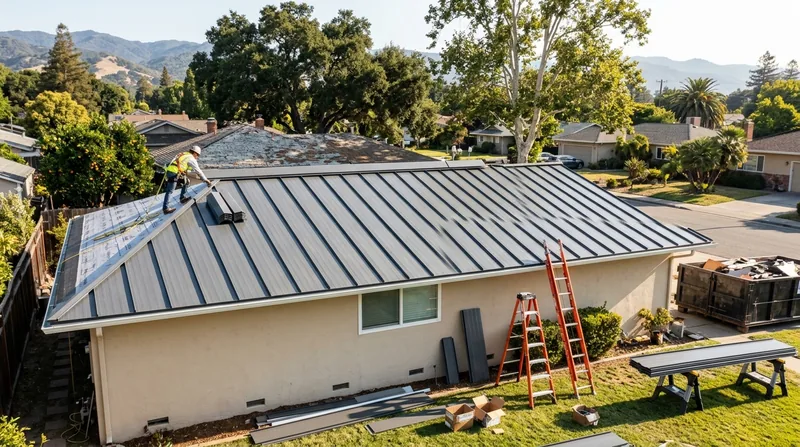




Metal Roof Installation in San Jose: Built for Valley Sun and Foothill Storms
Metal Roof Installation in San Jose is the long-term answer for homeowners tired of replacing composition or tile every 15 to 20 years. The Santa Clara Valley sits between the Santa Cruz Mountains and the Diablo Range, with strong year-round UV, long dry summers, and atmospheric-river storms that arrive fast in winter. That combination bakes underlayment, dries out sealants, and drives wind-blown rain into every weak flashing detail.
We install panel systems sized for this climate: high-temperature underlayment, correct ventilation, and fasteners rated for the local heat cycle. Foothill homes in Los Gatos and Saratoga get ember-resistant details at the roof edge and vents. Valley homes in Willow Glen and Cambrian Park get clean flashing lines and gutters that handle heavy winter runoff. If you are comparing systems, start with our standing seam metal roofing page to see what fits your roof pitch and budget.
Why San Jose Roofs Fail and Why Metal Changes the Math
Most San Jose roofs we tear off were installed in the 1980s or 1990s. Concrete tile in Almaden Valley and Evergreen has cracked under heat cycling. Composition roofs on 1950s-70s ranch homes in Blossom Valley and Berryessa are at the end of their second layer. Mid-century modern homes in Sunnyvale and Cupertino have low-slope sections where water sits and shingles curl.
- UV degradation breaks down underlayment and sealants faster here than in cooler coastal markets.
- Winter atmospheric rivers push water sideways under tile and shingles, finding every failed flashing.
- Tree debris from live oaks, sycamores, and redwoods traps moisture and grows moss on shaded north slopes.
- Wildfire ember risk in foothill neighborhoods makes Class A assemblies and ember-resistant vents a real requirement.
- Hail and snow are rare, so we spec for heat, wind-driven rain, and debris rather than ice loads.
A metal roof eliminates the recurring replacement cycle and keeps its finish for 40 to 60 years with basic maintenance.
Key info: A 1960s ranch in Willow Glen with a low-slope rear addition typically needs a different panel profile and underlayment than a two-story Mediterranean in Evergreen with concrete tile. We spec each roof to its actual pitch, sun exposure, and tree cover, not to a generic package.
For official permit requirements and inspection thresholds, always confirm with the City of San Jose building department before work begins.
How We Install a Metal Roof on a San Jose Home
Every installation starts with a full tear-off and deck inspection. We check for soft sheathing, failed flashing at chimneys and skylights, and ventilation gaps that would trap heat under the new panels. Then we build the assembly in the right order for the local climate, not the fastest order for the crew.
- We pull the permit with the local building department and confirm HOA or historic review requirements before ordering material.
- We remove the existing roof, inspect and replace damaged decking, and correct ventilation at ridges and soffits.
- We install high-temperature underlayment rated for the valley's summer heat, with ice-and-water membrane at valleys and penetrations.
- We set new flashing at chimneys, skylights, walls, and step walls to manufacturer specifications.
- We install the panels or shingles with fasteners torqued to spec and clips set for thermal movement.
- We finish the edges, ridge, and gutters, then walk the roof with you and document the installation for your records.
If your existing roof has only one layer and the deck is solid, a metal roof over shingles may save tear-off cost, subject to local code limits on existing layers.
Key info: On a 1970s Eichler-style home in Sunnyvale with a low-slope roof, we used a standing seam panel with concealed clips and a vented fascia detail. The homeowner in Cupertino with the same roof style got the same assembly, because the pitch and ventilation limits were identical.
Installation Approaches We Use Across the Valley
Not every San Jose roof takes the same system. Pitch, existing roof material, HOA rules, and budget decide the approach. Here is how the main options compare.
| Approach | Description | Best for |
|---|---|---|
| Standing seam | Concealed fasteners, raised seams, clean vertical lines | Low-slope and modern homes in Sunnyvale and Cupertino |
| Exposed fastener panels | Corrugated or ribbed panels screwed through the face | Budget re-roofs on ranch homes in Berryessa and Blossom Valley |
| Metal shingles | Stamped panels that mimic shake or tile profiles | Homes in Naglee Park and the Rose Garden with design review |
| Stone-coated steel | Granule-coated panels in tile and shake profiles | Mediterranean-style subdivisions in Almaden Valley and Evergreen |
| Copper and specialty metal | Soldered seams, natural patina, custom detailing | Custom homes and porch roofs in Los Gatos and Saratoga |
We match the profile to the house and the neighborhood, not to whatever is stacked in the yard.
Metal Roof Installation Cost in San Jose: What to Expect
Most San Jose metal roof installations start around $8 per square foot for an installed panel system, and climb from there. The final number depends on roof size and pitch, how many layers come off, whether the deck needs repair, and how complex the flashing is around chimneys, skylights, and valleys.
Homeowners in Los Gatos and Saratoga often pay more because hillside access, tree cover, and steep pitches slow the crew. A simple gable roof in Santa Clara or Milpitas sits at the lower end. Historic districts and HOA design review can add time and material cost if a specific profile or color is required.
Get two or three written estimates on the same scope. Ask what is excluded: deck repair, permit fees, gutter work, and disposal are the usual gaps. Our full pricing overview breaks down the ranges by system so you can compare apples to apples.
Metal Roof Installation Near Me: How to Choose a Contractor Near San Jose
Hiring a metal roofing contractor near San Jose comes down to paperwork, references, and specifics. A legitimate contractor carries both general liability and workers' compensation, and will send the certificate without a fight.
- Confirm the contractor is licensed and insured, and verify the license with the state board.
- Get at least three written estimates that list materials, underlayment, flashing, and disposal separately.
- Ask for two or three recent local references, ideally on the same roof style as yours.
- Check who pulls the permit and whether HOA or historic review approval is included in the scope.
- Read the warranty terms: manufacturer coverage depends on installation to spec, so ask who honors labor.
If a contractor cannot answer these questions in writing, keep calling. You can request a free estimate and we will walk your roof and put the scope in writing.
Metal Roof Installation in San Jose: Pricing Guide
| Service | Price | Details |
|---|---|---|
| Exposed fastener panel roof | Starting at $8/sq ft | Includes tear-off, underlayment, panels, and basic flashing; pitch and deck condition move the price |
| Standing seam roof | Starting at $12/sq ft | Concealed clips and custom panel lengths; roof complexity and access drive the upper range |
| Stone-coated steel or metal shingle | Starting at $11/sq ft | Includes profile panels and trim; historic or HOA design review can add material lead time |
| Complex or large-scale job | On estimate | Hillside access, steep pitch, multiple roof levels, and heavy flashing work need an on-site look |
| Permit and disposal | Included in scope | We pull the local permit and haul away old roofing; fees vary by jurisdiction |
| Estimate | Free | On-site roof inspection and written scope, response within 24 hours at (669) 274-4795 |
Indicative pricing, the exact cost depends on square footage, finish, and site access. Free personalized estimate within 24h at (669) 274-4795.


